Tuesday, 1 April 2025

Refit : Rudder and Centreboard Parts and materials

In 2023/2024 all nylon bushings and any corroded stainless or aluminum parts in the centreboard and rudder blade assembly were replaced.     

Replacement parts for CB and Rudder.

Parts ready to go!   Thanks to Thierry, Julie and the team at Alubat for going above and beyond.


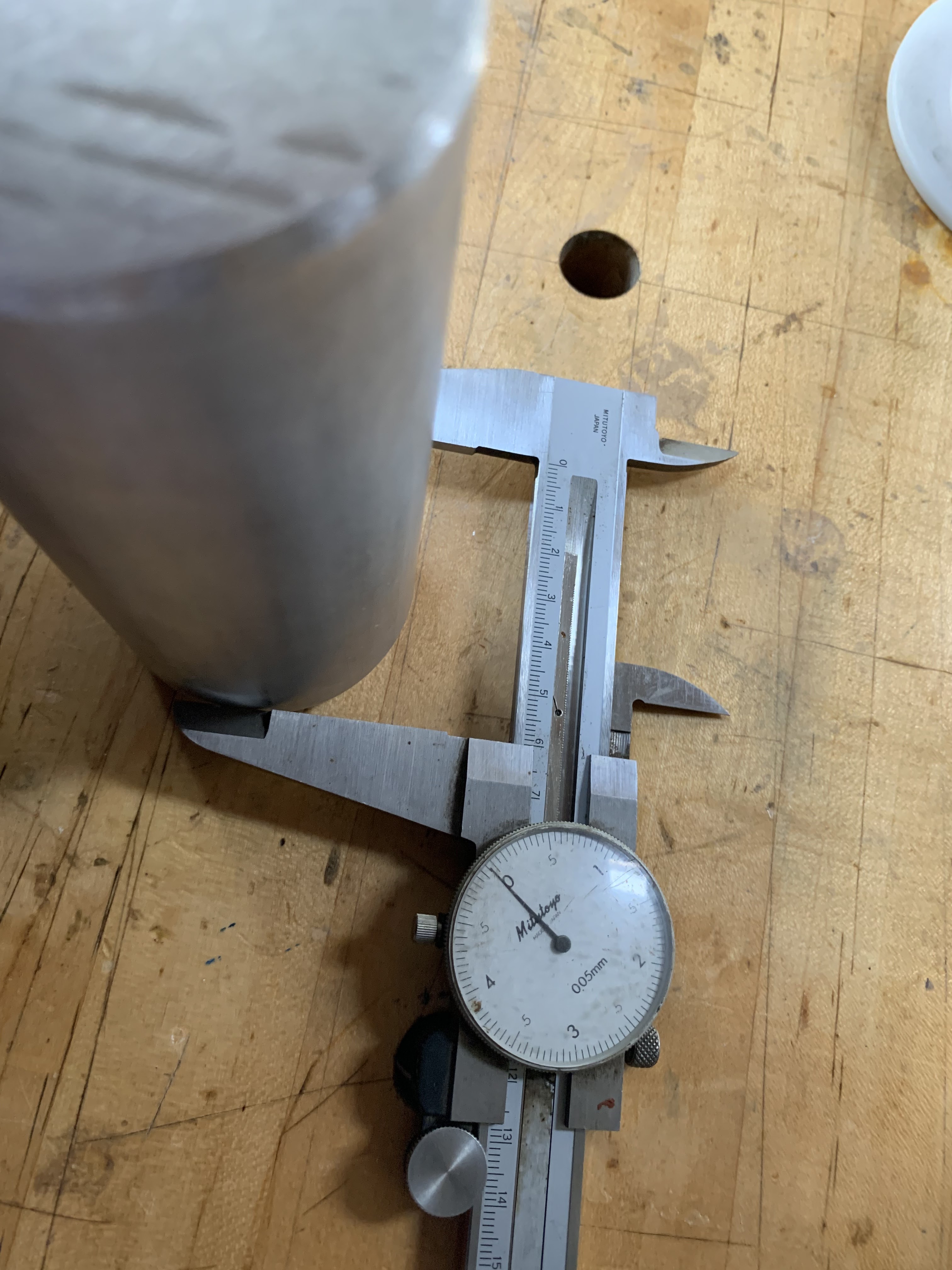
Condition of pivots posts and bushings.  

After 20 years in use, the rudder's ertacetyl bushings and aluminmum  posts required replacement.  The centreboard pivot was as-new.

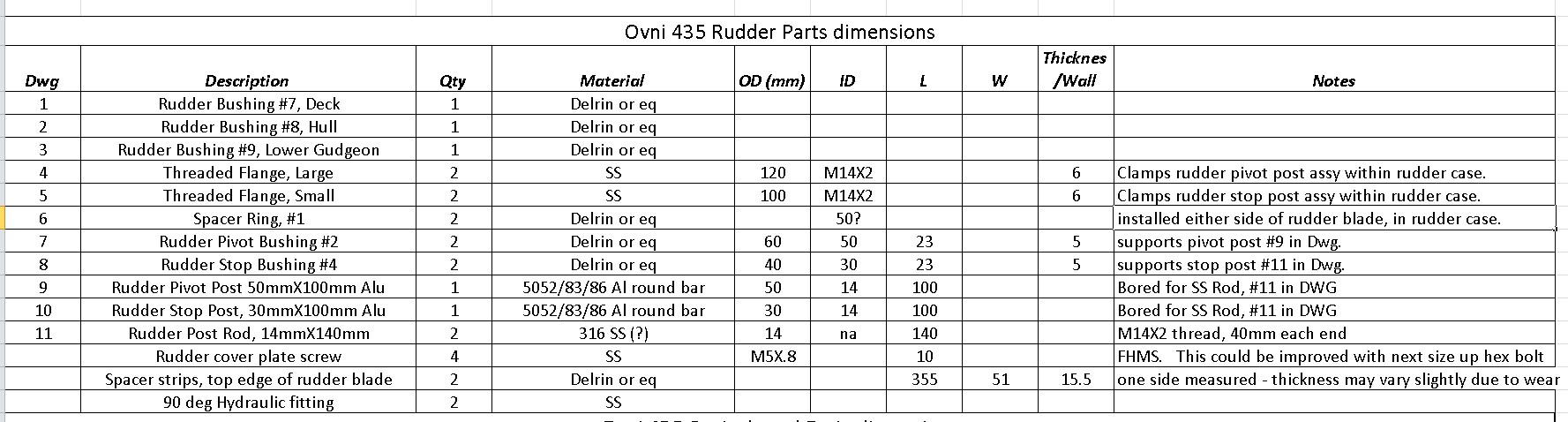
Rudder parts are pictured here, and are explained in English in the table below. 


Materials

Ertacetyl is the Mitsubishi trade name for acetyl plastic, one variant of which, homopolymer acetyl, is sold as Delrin. Here's an explanation:

https://www.aiplastics.com/blog/acetal-c-or-acetal-h/

(This material also appears in Hydroem’s cylinders, in that case the copolymer version.) 

Unfortunately, the grade of aluminum is not specified in the drawing.  Here's an explanation of the various alloys:


AC power infrastructure upgrades

The AC system was upgraded in 2024, and it works extremely well.  The AC receptacles are now a single system, seamlessly powered by an extremely smart 1600W inverter/charger supplied by the 430AH LiFePo house bank or by shore power via a 3600W automatic isolation transformer.   The isolation transformer protects both the vessel and its occupants from faulty shore power grounding, and permits the use of any normal primary voltage  while automatically supplying only 220VAC on the secondary side.   I also installed an 800w 125VAC inverter for North American appliances.  As a convenience, I installed a shore-power only 220VAC outlet in the cockpit locker to permit the use of appliances outdoors should it be desired.  The Victron components used are compatible with the Cerbo GX monitoring system, which has helped in commissioning  and in use.   

As purchased Sakura had a relatively new Victron battery charger and the original galvanic isolator as protection against leakage.   The AC receptacles were tarnished brass UK-standard units with some fed by a standalone 350w inverter, and others by shore power only.  Another add-on...

The boat is wired for 220VAC, fused for 10A meaning that the existing AC installation would not support the 15A required for a 115VAC conversion if for some unimaginable reason I had wanted to do that.   

Scope

The objective of this upgrade was to provide a safe reliable and simple-to-use setup with adequate AC capacity to power small 220V and smaller 120VAC appliances when not connected to shore power.  Hassle-free use of either 120 or 240VAC shore power was desired.  High current AC reqirements like fast charging,  air conditioning, induction cooking, or off grid use of powerful corded tools are not in scope.  

AC supply - shore power plus inverters: New in 2023/2024

  • 1ea 16A 230VAC twist-lock type shore power inlet.
  • 1ea 3600VA autotransformer (isolation  transformer)   This automatically detects primary voltage and will produce 220v on the secondary side.
  • 1ea Victron multiplus 1600VA inverter/charger.   This unit provides 70a of battery charging and 1600w @ 220v with numerous related features.
  • Victron 800/12/120 inverter.  800W 120VAC  - this is powered directly by  the "house" battery.  For future this may require a dedicated supply and breaker.

The system comprises:

  • Hubbell 16A 250Vstainless steel inlet, with its ground contact isolated from the stainless housing.  
  • Victron 3600 Watt Auto 115/230 V automatic isolation transformer, supplying a Victron 12/1600/70  1600VA inverter charger.

I chose a relatively small  1600VA inverter due to size constraints and use-case expectations.  12VDC Power is provided by a 430AH LiFePo battery bank, and should allow for the use of most small 220VAC appliances when on battery power only.   

  • Victron 12/800 (125VAC) inverter feeding two NEMA type receptacles is located beneath the navigator's seat.
  • The Victron devices are monitored by the Victron Cerbo GX.  This is located in the main electrical panel. The GX system is cool and I've only just begun to explore its capabilities.

The pre-existing UK style receptacles were changed to standard Euro configuration,  and the area decluttered.


Z-Spars Vang Z551-B2 / Hale-bas

The Z-Spars rigid boom vang was worn and was rebuilt in 2024 with parts ably supplied by Mike and team at US Spars

Oct 2023   Using localized heat and some thoughtful persuasion, The vang was disassembled on site.   The end fittings were brought home for repair and re-anodizing.  Metric AL tubing is not readily available in Canada or the US, so I ended up purchasing a length from  z-spars’ US distributor, US Spars, in Florida.   I also ordered two new sheaves, a new inner plastic sleeve, and new bushings.  The cost is about 1/3 of replacing the entire unit, and the parts were in stock and shipped immediately.  The end fittings were hard coat anodized in Toronto, and the vang is now reassembled and installed, as new.

Links

https://www.usspars.com/

Here is the actual model drawing

http://www.z-spars.com/download/hbr/Z551B2.pdf

http://www.z-spars.com/halebas-rigides-en.html

https://zsparsuk.com/wp-content/uploads/2022/02/Vang-specs.pdf


LiFePo Battery upgrade selection criteria (LiTime - Buyer Beware!)

What follows describes my purchase of 2 LiTime 230AH batteries, one of which was defective.   In a nutshell, while LiTime acknowledged that it had a well-understood defect, they would they would not provide a replacement without first receiving the defective one back, shipped at my expense.   The cost of freight ($635USD) exceeded the value of the battery, and they would not make an exception to their policy.  I was left with little choice but to buy and ship a second battery, risking a repeat of the same situation.  Thankfully the second battery worked (so far) and both are installed.  I again tried to revive and then scrapped the defectivc one.  

This was definitely a case where a low price had a high cost, and I will not deal with LiTime again.  Outside of the continental US there is effectively no warranty, even for a brand new battery that is DOA.  In the USA, the customer is still responsible to return the unit prior to (maybe) receiving a replacement.     


Prior Posts

Defective LiTime Battery

As discussed in the earlier post, (below) I purchased 2ea LiTime 230AH lithium batteries, and had them shipped to my my freight forwarder in Miami, and thence to Curacao.  
One of these turned out to be defective.  LiTime acknowledged this but was unwillng to replace it without first receiving the defective unit back, meaning it had to be shipped back to the USA at my expense. Shipping would cost $631USD to airfreight from Curacao. (the only option)   The battery currently sells for $614USD.
Given the cost involved in returning the defective battery, (I sent LiTime a copy of the quote) I asked them to simply ship the replacement to Miami, and I would pay (again) to ship to Curacao.  I did not ask them to do anything more than deliver a functioning battery to the same location in the USA as they had originally.  My ask was that they make an exception to their  ‘return of defective’ requirement, given the cost.   To me, this seems reasonable.     Fully aware of the situation they responded as follows:
This leaves me  the unenviable choice of:
    •  taking a chance ordering a second battery from LiTime, potentially getting another defective one and being out of pocket for TWO. (and still needing to purchase batteries)
    • buy and ship one from a better supplier to replace the defective LiTime unit, and use both, mixing battery/BMS systems. 
    • scrapping both of the LiTime batteries and replacing with those from a more reputable supplier.  
LiTime chose to hide behind a policy rather than of taking ownership of an acknowledged product defect in a new, unused batgtery, choosing to let the customer bear the cost.     Buyer beware!

Nature of the defect -

 liTime explained to me that  batteries cannot be shipped fully charged.  Sometimes the battery’s voltage drops below a safe threshold, triggering the BMS’s protective mode.  The BMS can be reset by applying a brief overvoltage to the battery.  Once reset, it will accept a charge.  I walked through this with liTime via email to confirm the battery (the BMS actually) was in fact defective.  Bizzarely, the supplemental documentation states that “ 85% of the time” this over voltage reset method revives the battery.  This leaves me wondering about their actual failure rate.  

Batteries 

Sakura's house bank comprised 4ea 110AH group 31 AGM batteries, plus a fifth one for the engine.  The house bank would therefore offer approximately 220AH of usable capacity when new.  These batteries were 5 years old and required replacement, providing the opportunity to upgrade to LiFePo.. 

Which form factors best fit the 435/6?

The compartment is below the cockpit, accessible from either aft cabin, and measures 22.5" X 30.25"X 9.5" deep with limited clearance above. There is  room for additional batteries elsewhere should that be necessary.  

Typical house battery sizes by convention:

-Group 31 Batteries:    13 x 6 13/16 x 9 7/16 inches (~13 x 6.8 x 9.44 inches, 330 x 173 x 240 mm), 

- 4D batteries: 20 3/4 x 8 3/4 x 9 7/8 inches (527 x 222 x 250 mm),

- 6D batteries: 20 3/4 x 10 x 10 1/4 inches (527 x 254 x 260),

- 8D batteries: 20 3/4 x 11 1/8 x 9 7/8 inches (527 x 283 x 250 mm).

"We emphasize these 'maximum dimensions' since some of the BCI group 8D batteries are closer to group 6D or group 4D, but they are still labeled as 8D battery group and similar."

The BCI group sizes are very relevant for vehicles, but less so for off-grid applications where specific mounting methods and wiring configurations are not a consideration.   Thus, many larger form factor (4D and up, 20" in length)  drop-in LiFePo batterries are being produced that vary in dimensions and terminal styles.  One of the challenges involved is getting these larger sizes in and out of the 435's battery compartment is the limited clearance above.        

This challenege was addressed by cutting down the side of the box in Maria's  very large installation.    Impressive.    She also provided me battery compartment dimensions at 56x76x23 cm.     (22X30X9")   Thanks Maria!   

After some research, I purchased 2ea of the following as a first step.   At 230AH each this doubles the existing house bank capacity.   


Posts by Subject

Most popular posts