Sunday, 9 March 2025

Curacao notes.


A side note:   Am back home now.  Robert  visited last weekend and remarked on how courteous and easygoing the people are in Curcao.  He said it really surprised him.   I agree and would add  that businesses are largely entrepreneurships and are generally very capable and courteous as well.   The Dutch-run businesses are well- run as one would expect in Northern Europe, the locally-run businesses are often very good as well, and the Chinese merchants run their enterprises much as they do elsewhere.   Curacao is a high functioning place - kind of ‘second world'  if that makes sense.  I've been told though, that construction may be a challenge (impliction was corruption/theft) and that getting things like internet service set up can be painful.  

Barred windows and segregation of cash handling in many retail places speak to the presence of petty larceny though my last Airbnb host left the place unlocked for me.   I never experienced anything of concern but I would take normal precautions against petty theft. 

Money

The ABC islands are part of the Kingdom of the Netherlands but are not part of the EU. Currency is Netherlands Antilles Florins (NAF or Fl) commonly known as guilders, also used in St. Maarten.   US dollars are readily accepted everywhere at what appears to be a standard exchange rate. Some Canadian dollar credit cards, used with some merchants' terminals will process a charge in NAF, some won't, and you’ll be billed in NAF.   You will often be asked "dollars [US] or guilders?" 

It is handy and respectful to have cash in guilders. Finding ATMs that are inexpensive can be an issue, RBC Royal Bank (recommended) provides US dollars or guilders with a $6US service charge, Banco Caribe is a rip off, (NAF only, 14fl charge 100fl max) MCB (another local bank) only offers Guilders or Euros and the fee is $10.  The financial district is in the east side of Shottegatweg, just east of the Zeelandia area, and north of the roundabout of reckless abandon.*   ATMs can be found everywhere but as mentioned they vary…

Language and communication

Papiamentu and Dutch are the official languages of the ABC islands, but Papiamentu is the most commonly spoken and is on most signage. You will hear some Spanish being spoken as well, and English is pretty well understood.  If you can get a Papiamentu phrase book it would be fun.    I have completely failed to pick up any of the language  though I did buy a two-volume crash course.book store and cafe.  

Make sure you have Whatsapp and use it for your primary means of communication.   Everybody there does.

Emergency numbers


AirBNB  I've stayed (in reverse order of preference) in:

  • Two different multi-storey very budget hotels downtown.  (weird but funny, shabby, boring, no kitchen - short stays)
  • One mother-in-law suite under and behind a posh residence in a gated villa community  (nice but really boring and I felt like Harry Potter living under the stairs) 
  • one scruffy little apartment in a very modest neighbourhood near Mambo beach.  (was in a jam, it was OK, with a resident cat that was so domineering it became annoying) 
  • One very nice apartment near the Mahaai neighbourhood.  
  • One OK apartment in a nice house at the end of a very rough (appearing) street.   (chickens galore, two daschunds with hip-hop names, wild parrots and iguanas, and huge domino games down the street. )
  • One apartment in the heart of Salina    (great host, super convenient, entertaining density of dogs, chickens, neighbours). Very near the roundabout of death.*

These are all in Willemstadt proper, within a 5km circumference of SE willemstadt, where my boat is located.   None are near beaches or have pools, so I can't speak to a more "holiday" type experience.  I prefer "going local" - it’s just more interesting to me.  any non-hotel I’ve stayed at really needed a car to do anything.    

As always with Airbnb, bring your own kitchen knives.    For some reason, no Airbnb I’ve stayed in Curacao had a veggie peeler.  Only one had a toaster.   Coffee making is hit and miss, I always bring my moka pot from the boat.  (And pots, and knives, etc). Kitchen ranges are typically propane.  Tank outside, if it doesn't light, check the valve.    It is good to have a washing machine, a dryer is not necessary.  I’ve yet to see a place with one.  I’ve not yet encountered a place with a bbq, nor have I noticed anyone using one.    

Many places don’t have hot water, it is not required, the water is plenty hot after the pipes have been in the sun all day.   

Most places have room-level air conditioning that is only turned on prior to going to bed. The main living areas are often not air conditioned, but typically have fans.  


The Water

The tap water is fine to drink.  Typically I fill several 1.5l water bottles every day.  I freeze some and use them in the boat icebox to keep my lunch and water cool.  I usually have 5-6 on the go.  A good trick for outings I think.  

I’ve never been sick at all in Curacao, not even any minor digestive adjustment.   


Paying for electricity

Electricity is 110 V, North American receptacles but most places have a 220v outlet (also North American.)

Electricity is purchased at gas stations offering a service called Pagaifasil, or Pagatinu which provides  a receipt with a code you enter in the keypad in your unit, that allows you to pre-buy electricity and pay per use. I believe you need the account number.  The owner will have pre-bought several kWh for you and will likely expect you to leave with ‘the tank full’ or leave cash in lieu of. 


Garbage and Recycling

Garbage bins are outside and collected once a week.  I learned a trick with inside containers and that is to leave the bag in the container as normal but twist the bag shut or trap it shut with the lid.  This keeps the flies/fruit flies at bay and saves you taking out the garbage twice a day.  (Remember, the living space is typically not air conditioned)

Recycling is done at grocery stores and elsewhere.  Look in the parking area for a big brightly-painted dumpster-like thing with holes in the side, labelled for the various materials.  They don’t take glass, cardboard or steel near as I can tell, just plastics and aluminium.  


Dogs, Cats, Birds, Lizards, Bugs


Windows don't have screens as there are far fewer bugs than here in Canada, and I think that in a clean inhabited place, the geckos make short work of any bugs that might be around.   You can get some small mosquitos in the evening, and most places seem to have a can of insect repellant available.   (I am not an attractor of mosquitoes, however my wife and my son Robert are.  I know Robert was frustrated by mosquitoes at one point.)   I have found that feet and ankles can be targeted by no-see-ums or something (ants at the boatyard some months) so I spray  for that when I notice it happenng..   Seems to be seasonal.  

There are tons of dogs and many cats around.   You'll notice the dogs seem generally healthy and well cared for unlike most in the Caribbean.   I've never found them unfriendly, though they will piss on your car and maybe any stuff you leave around.


Chickens abound, even in the denser suburbs.   (though not in the 'gated communities' and such.)


Food - Groceries and other essential shopping

Shopping hours are pretty liberal in Curacao, check each place online.   

For stocking up on paper and washing type stuff when you first arrive,  there is a place called Goisco which is essentially a small Costco.  You can’t bring backpacks or bags inside, they offer lockers.     It has a pretty good selection of produce and also, prepared foods - super popular at lunch.  . Sunscreen isn’t as widely available as in the North, consider  bringing with you.  It is stocked at Van Der tweel and in the children’s section at Goisco.  

Supermarkets are pretty good and are far more varied and less corporate than at home.  They are independent and reflect their owners and clientele. Refreshing!   Often there are take out lunch counters and small restaurants associated with the store, there are inexpensive and seem popular at lunchtime.  


Here are a few of the stores I use regularly, there are many others:


Van Der Tweel  in Zeelandia is clearly Dutch and is a bit expensive but has the best bread, and also fresh squeezed orange juice.  Think of a Euro whole foods or Farmboy.  I've seen a farmer's market in their parking lot on Saturday mornings, but that may be seasonal.   They have another location in Jan Thiel.


Centrum in Mahaai is like a Canadian supermarket in feel and has very good produce 

Best Buy supermarket is clearly Asian and is not unlike Blue Sky, TNT etc  Near Salina.  Crazy good assortment of Asian and European sauces and stuff, as welll as meats and (frozen) seafood.   Also, cheap cookware/bowls for anything the Airbnb might be missing.   I think they do a cash and carry type business with smaller stores, their inventory is impressive.   

Mangusa hyper market is an experience.  Kind of like highland farms meets the West  Indies on the Friday of a long weekend.   https://www.mangusahypermarket.com/

The local ‘Chinese shop’ thrives all over the place, and is usually a hang out in the evenings.  They have staples, cold beer, a few fresh items, and a range of stuff catering to the neighbourhood.  Fun.


Luna Market  on Caracasbaiweg is a weird asian place with mislabelled aisles and a unique assortment, including cookware andtools and hardware.   You can get "Chinees Etes" at lunch.      Produce is OK, and they carry local starches and veg.  


The fruit and veg you’d normally buy at home is all imported, often expensive and is not always the best. I haven’t learned how to cook the Caribbean stuff well, but have experimented with a few things and was glad I did.   On a long vacation this would be fun to do this with some intention.    Lettuce isn’t always easy to get but spinach  (and other greens) is and cucumbers are.  Plantains keep well in the heat and are understandably a staple.  Buy green and fry ‘em up when ripened.  (Refrigerate after cooking too) Bananas have to be eaten quickly.    Papaya is inexpensive and good for breakfast.  My go-to was muesli, sliced papaya and banana and Greek yogurt from the Netherlands  (cost just over half what we'd pay here)  and milk, all of which is available and inexpensive, and seems to suit hard work in a hot climate.  As with many places, eggs are not refrigerated and don't need to be (until they have been, once) 


For fresh fruit and veg In Punda (the old downtown) there are fruit/veggie/fish stalls daily at the floating market.


Kooyman in Zeelandia is a very well run home Depot-like business, should you need that.  


Food - Restaurants

There are many, many restaurants in Willemstadt,  and I’ve barely scratched the surface as I’ve generally cooked for myself.  

If you want ‘kuminda krioyo’. (local creole cuisine) you must find  it at midday as these local places are closed in the evenings, frankly, the larger mid-day meal and and a mid-day break makes much more sense in the climate anyhow as I’ve learned working on the boat.  (I was there in summer during a heat wave...  It was dangerously hot for working, especially inside an aluminium boat.   Be careful, I did learn to recognize the onset of heat exhaustion.  I also developed a nasty heat rash, apparently an auto-immune response.   This only when the daytime temps were 36-38 deg and I was working.   32deg, (winter) no issue. 

In the Punda   Plasa Bieu is big eating hall place where prepared lunches are sold by various vendors.   Good and neither cheap nor expensive.  (Didn’t try the iguana soup but the conch stew was excellent) 


There is a weird hotel generously called ‘Curacao Suites’ that has a rooftop Indian/seafood restaurant.  If you want an Indian restaurant they bring one menu, if you want a seafood restaurant, they bring the other…. lol).   The owners are Indian and the vibe leans that way, and it seems to be well supported by the local Indian community.  Very recommended.  Some Indian celebrity was there when I was one night and a great fuss was being made.  

Everywhere you’ll see Chinese (typically) bar/restaurants.  These are like our local ‘greasy spoons’ and are where tradesmen etc  eat lunch.   They often have barred windows at a stand up/takeout area and a few tables inside.   Like the local "Chinese store" these don’t look very much like home, and are not inviting to Canadian eyes,  but don’t be deterred.    Some seem to operate like ‘the local’ in evenings in the UK.  Below in busy Salina.   


There are stands/stalls selling batidos (fruit drinks) and  meat patties, and arepas.  Typical lunch fare.  You will commonly see Kuminda Surinam as well, the old dutch Guyana. 

In the Zeelandia Mall there is Kafe 5999 a small Cafe, really good coffee and treats. 

Recommended but not tried is Pizzaroni, on Caracabaiweg near the roundabout of infinite patience.  

you can get a good sandwich and probably other stuff when out shopping in zeelandia at this Quick Food lunch place.  

Ther eare numerous restaurants in the Jan Thiel/Spanish Waters area catering to tourists.  

For a nice outdoor meal on Caracasbaiiweg try disrutas mas (local recommendation and my own) which is right beside this interesting outdoor food court place I've never tried but for the ‘Bo Kofi’ excellent coffee.   Pasawa Box Eatery  Definitiey hopping on weekend nights, maybe a hangout for youth.


Buying Gasoline

When you buy gas you prepay, through a barred window cash only.  Dollars or NAF.  The pump is yellow for gasoline, black for diesel.    Figure out the capacity of your car’s fuel tank and buy what you need or you’ll overpay then be overfilling it and dumping it all over the ground like I did. 


Cars and driving 

A big vehicle would be a pain to park and navigate in curacao.  

There are ‘local’ car rental guys that are much cheaper than Avis etc.  Also, a big brand name (Avis) is not a guarantee of a good car, as I found out.    (Worst I've had- totally trashed)   I’ve had very good luck with Europcar who are a traditional agency, well run, nice cars)   On my most recent trip, they had no cars so I was connected with Huurauto- one of many of its type,  for $40usd/day. (could probably get it cheaper.  Was met at the airport by the owner "Soni" (Sonny) and got a beat up Kia Picanto.  Paid cash, insurance docs in car, not sure I want to test it.  Got a flat and changed it for the temp spare, and whatsapped Soni to let him know.   He dropped what he was doing, met me at Goisco to take the old tire then met me again an hour later at my airbnb where he Installed the new tire.  This was on a Saturday during carnival weekend. His wife and young daughter met me at the airport drop-off lane to return the car.   Super nice people.    I was also approached by the young night guard at the boat yard - he rents cars as well.   Apparently the government supports small-scale entrepreneurs and makes it easy for them to operate..  If the renter doesn't do it for you, take a video of the car and share with the renter via whatsapp.  Soni did this.   Make sure the car has a decent spare and proper jack and tools.   


The sun,  potholes and speed bumps are very hard on vehicles.  Be careful at night as the streets aren’t lit and the speed bumps are big and hard to see.  

Also be careful at night because it is very common for people to run red lights just after they’ve changed.  

It is illegal to turn right on a red, and each direction will have its own light.  These are positioned differently than here and at first you will pull too far ahead as you approach the intersection, and will be unable to see the light:  

You’d better look up how to interpret the yield/right of way signs yourself.  I'm sure I have it wrong.  


Traffic can be bad, at morning and mid day especially at the various roundabouts (except the roundabout of reckless abandon).  Caracasbaiweg is a busy road linking Jan thiel to willemstadt and it can get quite jammed.  Try to avoid that and Salina at lunchtime.  


Where to stay


The best ‘in town’ areas to stay are probably Otrobanda and the more upscale strech along Pietermaai.  Both are in or within walking distance to the centre, and have nicer restaurants and boutique hotels.   (both recommended by my last AirBNB host for your purposes.)

It appears that most of the higher end guest-type places for rent are in the Jan Thiel/Spaanse Wasser area, east  of the city.  Jan Thiel appears most "walkable" for shopping and stuff.   Have driven by some of it but not explored.    


Wikipedia etc

https://en.wikipedia.org/wiki/Pietermaai

https://en.wikipedia.org/wiki/Otrobanda

https://en.wikipedia.org/wiki/Spaanse_Water

https://www.janthielbeach.com/


Tugboat beach at Spanish Waters is/was an oil terminal (now closed) and is where they still service ships and oil rigs.   


Recreational Shopping

I dunno…. Ask me about welders, machine shops, and fastener suppliers.   There are malls and stores like anywhere.  Local, European and foreign sure American in flavour as well.  


Misc


Apparently the most beautiful places to drive to are the more natural areas, west end of the island.  Best beach at Westpunt apparently and you can swim with sea turtles.    I havent seen that part of the island myself.  Its only about 40 min from Willemstadt.  My AirBNB host was mad that I didn't take Robert there.  


Diving is a thing and you can get licensed here.   Might be fun for your group.  As might deep sea fishing - also a big deal.   The boatyard owners are avid fishermen with very fancy boats, and I'm sure they could recommend a charter.  


Carnival is during the first weekend of March, it’s a big deal here   Be aware of other stat holidays as well.   


I know two people who offer Island tours and a few who could provide more advice if needed.  


Also, seach Whatsapp for Curacao visitors or similar.   You may find English language chat groups.   There are two for sailors (normal these days) but it wouldnt surprise me if there were similar ones for terrestrial tourists.  


Fabric and Sewing  

Turbo Machine Shop


Kennia Sewing 


Goisco (like Costco)


All signs (for plastics)


Hydraulics shop.  Erik is an awesome guy.

https://www.hydrostorecuracao.com/


Edwin Versteeg, Surveyor.  Another smart, helpful person.

https://edyachtdesign.com/


Insurance.  Laura is extremely resonsive and very knowlegeable.

Laura Lindstrom-Croop

INTERNATIONAL WATERS INS. SERVICES

411 Walnut Street #14847,  Green Cove Springs, FL 32043

Website: www.MarineInsurance.cc  | e-mail: Laura@MarineInsurance.cc  

Fax 443-926-0580 | Phone (904) 705-4485


Freight forwarder from Serge 


Lynette Reyes


AmCar Freight, Inc.

10100 NW 25 Street

Miami, FL 33172

Tel: (305) 599-8866 - Ext 129

Fax: (305) 599-2808

Lynette@amcarfreight.com

www.amcarfreight.com


Another, From Laura 


When we were in Curacao we used Cur-ant Transfer, they have a facility in Miami, they will collect packages from all over and combine them on a pallet for you. You just need to provide a list to them of what is coming from where, we just sent copy of receipts.

Email debbie@curcargo.com or call them 305-251-1460.  Their rates were very reasonable, service not the best, I never got a quote ahead of time but the shipping costs

Always seemed reasonable.  They own their own boat that comes to Curacao once a week so if all your packages are there by Tuesday they go out on the Thursday boat, or something like that. They also go by Florida Express.  Their office is 2 miles from the marina, its cheaper to pick up items yourself, but they will deliver to the marina, there is a charge for this.

Items go thru customs but as long as you have your boat papers there is no duty.


Sunday, 2 March 2025

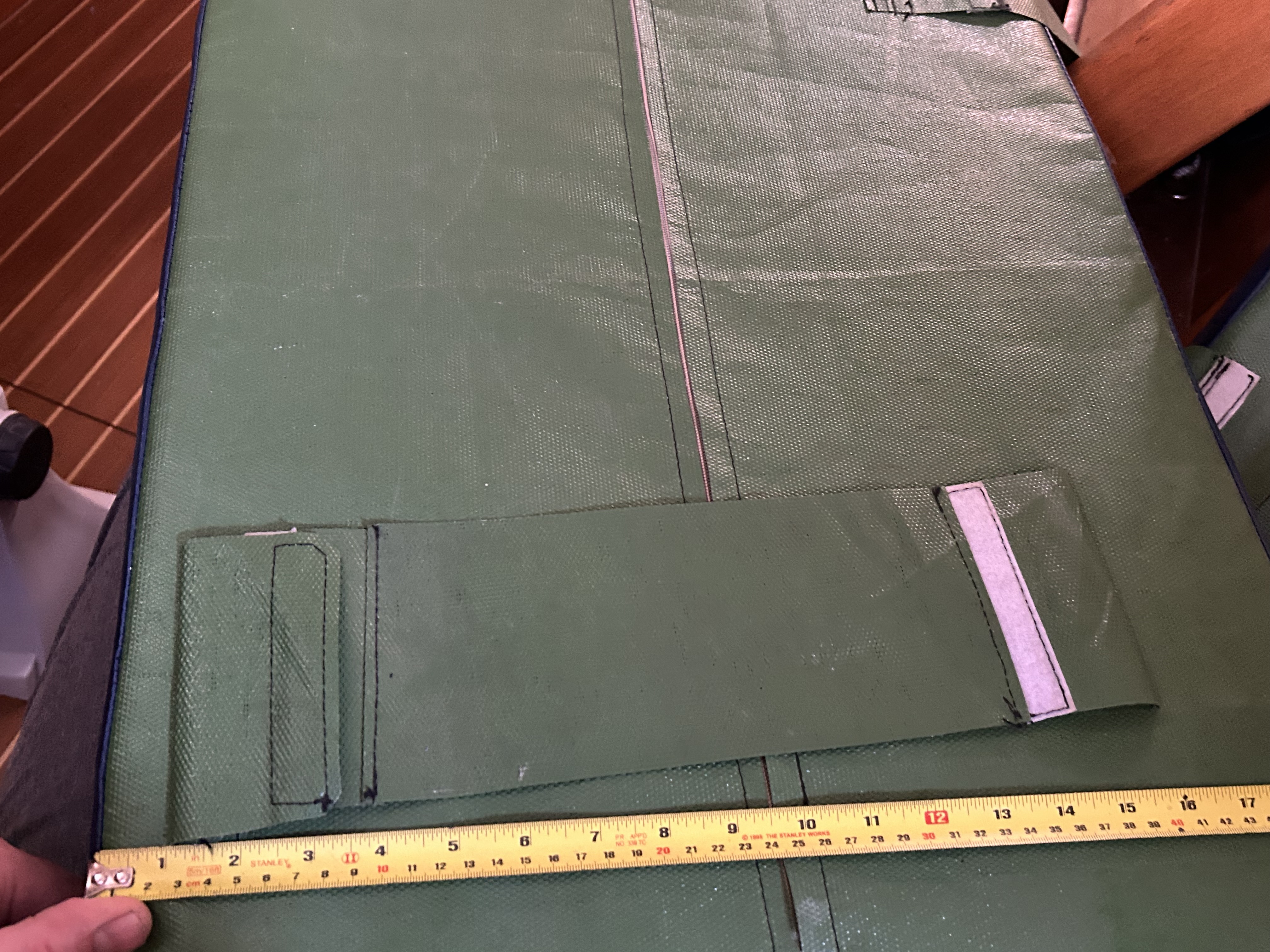
Cockpit cushions


The cushions that came with Sakura are in excellent condition but are bulky and difficult to store.  (That said, they may have an unintended benefit of taking up space in a sea-berth.)  I may have enough higher density closed cell foam to make better, thinner cushions.   

Photos for dimensions below.   


Wednesday, 26 February 2025

Securing the cockpit seat slats


There has to be a better way….


Removing rivets

13/64 bit to drill out rivet.

5/32 bit to bore out rivet


Saturday, 21 December 2024

Watermakers

Other than being aware of the need for fresh water, the periodic challenges procuring same.  I had given little thought to the matter.  As the refit progressed, brain began to turn to water, and  based on an enthusiastic recommendation from a cruiser met in Curacao, I first began to explore the company Seawater Pro.   I thren asked around online and gained an understanding of other systems (and their cost) and eventually returned to Seawater Pro.   Why?   While most other systems are more refined and efficient, and are commensurately more expensive, with more esoteric pumps and motors.   This makes sense given the traditional high cost of battery capacity and electricity generation, however in a real world use case, electrical efficiency is no longer a key consideration.          

So, Seawater Pro offers a range of systems, but their system typically comrprises:

  • Reverse osmosis membranes.
  • seawater pumps - a small 12VDC liftpump and  a much larger high pressure pump, 12v, or 120/240VAC)  
  • Electrical circuits for powering same, incl switching and protection..
  • A pressure regulator to ensure the membranes see adequate but not excessive pressure.  
  • An intake strainer* and two stages of pre filtration.
  • A means to discharge brine.  (the salts and impourities removed from the water)
  • A means to flush the system with fresh water, to ensure that marine organisms don't colonize and contaminate the system.  The seawater pro system has a flush timer and circuit to accomplish this. (this is a battery powered sprinkler timer.)    
  • Gauges to measure the input and output pressure of the sytem, and a TDS (Total Dissolved Solids) meter to infer water quality.
*not provided with the Seawater pro kit.

Connections

Power - two connections.   the system requires two power sources - 12v at nominal current to operate the boost pump, and sufficient AC or DC power to operate the Main Pump, depending on pump motor chosen.  

Plumbing- four connections.    The system requires a seawater intake via a strainer, and a brine discharge overboard.   Purified water should be discharged to the tank via a diverter valve to also faciliate filling of jerry cans and an initial system flush.  System backflush requres a pressure water connection to the timer.    

Power Options   

The 220v 50-hz AC motor requires 1000w to run but much more to start.   This inrush current must be considered in sizing the power supply..   My 1600VA iVictron Multiplus nverter/charger can provide a peak of 2800w, and 1100Wcontinuous at 40 deg c, but when power factor and inrush current are considered it is undersized.    

Similarly, the 600w 12V motor could be connected anywhere, but most conveniently to the esisting 1000w windlass circult.   

While this seems like the most obvious solution, given the access to a high current 12VDC circuit, Seawater Pro strongly recommends the use of an AC motor whereever possible, because:
  • The industry standard 1hp AC farm duty motor is  brushless and very long lived.  (and can probably be serviced anwhere in the world, or easily replaced) 
  • The AC motor supports 40gph  (151 litres) dual membrane operation vs 17GPH for the DC motor.  
  • The DC motor requires brushes and is known to be less reilable.    
So, the DC motor will need to be run for twice as long to acheieve the same result. 

Use case:
3 crew using 15 US gallons/day.  would roughly require replacing water at the rate running the watermaker  for an hour every 2-3 days.  One hour of use represents 83 ah of stored electricity. The large buffer provided by the 600l   .(160 US gal)    

This belatedly brings about the real challengie with this (or any) system, and that is location.   Because of the  size, power and plumbing requirements, there is no signle, obvious location. The only area in the boat which provides proximity to all of the required connection points in the forepeak, which is not a bad choice anyway.  This may change when it comes time to install.


https://seawaterpro.com/


https://skwatermakers.net/collections/watermakers/products/ez-501

https://citimarinestore.com/en/village-marine-ltm-series-watermaker/16933-parker-ltm-145-watermaker-145-gpd-12v-membrane-included.html


Monday, 23 September 2024

Locks and keys, small detail, deep rabbit hole.

Quest for duplicate keys 


Sakura came with a pile of keys, none labelled, and only one for the main hatch.   I sorted out the lot, tagged them all, and decided I should have duplicates for each and a few extras for the main hatch.

 “In 33 years I have never seen that key”.   Thus spake the learned locksmith at Kennedy's locksmith in Willemstadt.  Not surprising and I'm sure he knows his stuff.    I will order blanks and have him cut them on my next visit.  (There's always something that has to wait till next time.)


Here's an enlightening exchange on the alubat FB group.   Thanks Mac!


The conversation continued.  My thanks to Alubat FB group members for providing assurance that this is a common key (and for cheap locks!) in Europe, and particularly to Anne-Marie, who photographed her recently-cut keys, their manufacturer and part number  Silca UL060.   


Which cross-references to JMA U-2D, a part number which seems to exist in North America, however is not commonly available as such.

$7 for the keys, $75 to ship from Texas to Canada!


Bill F later indicated that an Ilco (a brand commonly available in Canada) 997B worked. 
So, following the next cross-reference trail from Ilco 997B, leads to yale 7D, and another online source.  https://www.clksupplies.com/products/997b-yale-key  I have emailed some local suppliers on this SKU.  


Apparently the following are equivalents:

ANIS A21
CANAS UVS2
CEA UN10
CHARLES BIRCH 5851
ERREBI U4PD
JMA U-2D
KEY-LINE UN4PD
KIS U20
LOTUS UV4
ORION UNL4P

Silca: UL060

Silca: ULO60

JMA: U-2D

JMA: U2D

KL: UN4PD

Orion: UNL4P

CEA: UN10

Anis: A21

Lotus: UV4

C Birch Hook: 585


Add (possibly) for North America

Ilco 997B

Yale 7D


Sunday, 15 September 2024

Solar Power generation

Solar Upgrade


Update April’24
After a season of cruising I elected to start from scratch and have a professionally built aluminum solar panel frame welded to the arch.   The frame weighs just over 10kg and is extremely rigid,   Priority was given to strength but also to simplicity, ther are no support posts or tacked on struts.    the panels lie flush between bed rails of 30mm angle aluminum.  


I chose this configuration because it was the largest I felt comfortable  installing.  Having spent a season with 400w I am confident that 600w will be adequate for modestly heavier use or lower sunlight availability. 

Armed with a little more k college and experience, and some great advice from experts on online, I elected to mount the 3x200w Renogy solar panels, each with own Victron 75/15 MPPT.  This creates three independent systems, and confines shading losses to one of the panel and cotroller shaded.   The panels are mounted longitudinally so any shading (by the mast) would impact only one of the three at any moment.  
Each of these panels can generate up to 230w peaks at 37vdc, which I find impressive.  


Prior post 


Based on the conversations detailed in the earlier post (below) I decided to remove the wind generator, which was obviously shading the solar panels.      This and a good cleaning saw the 2X100w solar panels produce much closer to their nominal 200w.    Regardless, I have decided to upgrade the solar panels to a nominal 400W.  This will help offset the loss of the wind generator, and should, in sunny regions be more than enough to keep the batteries charged.   (I duly note that most cruisers opt for more than this)   
I was concerned that I could not find a form factor that would not exceed the width of the arch.    Fortunately,  Renogy offers a size that fits in a 200w 24v panel.  A pair of these should fit comfortably within in the existing width, while extending only 8.5" further fore/aft.       (49.7"X 30" vs 47X21.5")     https://www.renogy.com/renogy-16bb-n-type-200-watt-24v-solar-panel/
Each 24V 200w panel  will produce around 5 amps at 37V, and obviously the pair will produce double that.   The existing Smartsolar 100/30  MPPT controller is therefore just adequate for the pair.   (100V is max input voltage, and 30A is max output current.  400w  at 14.6V=27.4a.)  A higher output or second MPPT controller should probably be used, so I purchased a Victron Smartsolar 100/50 for this purpose.   This provides redundancy plus a variety of wiring options, including series wiring, two controllers etc.   
The obvious advantage to any higher voltavge/lower current PV installation is that the Victon MPPT controller does not operate until the solar panels produce 5V more than the set battery voltage. (14.6VDC in m case).  This means that with 12V panels, in lower light conditions the MPPT might not be producing at all
  has a floor voltage meaning, 
While I do not wish to install any more fixed panel area at this point, the existing panels could be used at anchor if I cared to fabricate some sort of removable bracket.  

Original post.


Sakura came equipped with 2X100w parallel-wired Victron SPM100-12/3a solar panels and a Victron 100/30 MPPT controller, charging an aged 4X100AH AGM house bank. (since scrapped and replaced with 2X230AH Lithium)  These panels have kept the house bank charged while the boat has been on the hard and during my periodic refit visits over the past year.   
As discussed below, these panels are producing less than 100w under ideal solar conditions.   Each is producing a similar 40w individually.   What is obviously not ideal is the presence of the wind generator directly above the panels. It appears that the wind generator installation may have preceeded the panel installation, resulting in shaded panels.  
Reimagining the use of the arch, and updating the bits mounted thereto is a project in itself. 
The MPPT controller will be moved to the electrical area under the port side aft berth.  The solar panel wiring will be brought to that location also so that series/parallel can be wired there.  


In May 2024, I finally decided to download the Victron app and see (via bluetooth from the MPPT controller) what the panels were doing, and was surprised to find that the two were typically generating a total of less than 100W total.  50-85w typically, at 16-18VDC.    This at mid-day, in the tropics.   When connected individually, both panels behaved similarly, with each generating 25-40W.  

Based on my experience with a 175watt installation on Windstar, which generated much more electricity,  I find it hard to believe that the panels are functioning as they should. 

I havent yet had a chance to methodically examine this, but I did post online, asking the following:.  
  • Is this normal with these panels?  
  • Are the panels failing? (identically?)
  • Could tired batteries be the cause?
  • Could there be an issue with the MPPT controller?
  • Could the controller have been programmed in such a way as to cause this?
Responses were:
  • Panel is shaded, mostly by the wind generator.  This will significantly reduce output.
  • Connections should be checked for corrosion.
  • MPPT controller may be more efficient if panels are connected in series.
  • A seperate controller for each panel is ideal.
  • Bifacial or better quality panels (CIGS) would help.
  • panels will rarely be at 90deg to the sun, significantly reducing efficiency.
So, the strategy might be to:
  1. clean up the connections 
  2. remove the wind generator 
  3. re-wire panels in series.   (and compare)
  4. measure output with each change. 
Panel dimensions are 47X21.5", frame is 1.375"h
mounting frames are 23 3/16" o/c


DC Infrastructure: Storage, charging, monitoring.


I purchased Sakura knowing that her 5 AGM batteries required replacement.   Having had a great experience with Windstar's solar and LiFePo battery upgrades, I looked forward to taking this step with Sakura.

Sakura was built in 2001, and since then there have been leaps forward in battery technology, charge sources, combined inverter/chargers, and smart options for monitoring and controlling the entire system.   Components are inter-related, and each should be considered as part of a system, which itself should be designed at the outset with clear and realistic use cases in mind.  Sakura had some good pieces, but these were a series of add-ons rather than a coherent system upgrade.  

The AC infrastrure is discussed here.

Scope

The use case for Sakura is to be completely independent of shore for water and energy for extended cruises and living aboard, with the exception of propane as a cooking fuel.   Air conditioning is not in scope.    With that in mind, upgrades were made, resulting in the following:

Monitoring and Control

  • 1 ea Victron BMV712 battery monitor, (existing) repurposed as a DC current meter for the the solar and hydro generation.  
  • Victron CERBO GX installed to monitor all systems.  New in '24.  This provides a single access point for monitoring and controlling power..
    • Connectivity can be made via bluetooth, Wifi, Ethernet, and a cabling scheme called VEdirect which uses JST PH series, 2mm pin headers.
    • The interface is through direct connection to a touch screen or via an app on a PC or IOS/Andriod device.   
    • This technology permits GX compatible, components system to be monitored and controlled from a single point, in a consolidated way, most often from the nav station where most other systems converge.  
    • The entire system can be monitored and configured remotely via the VRM portal.
    • smart shunts can be added to provide GX monitoring of non compatible devices but that's not in scope at this point.     
  • Victron Lynx Shunt - this is a smart shunt that provides data on the batteries and energy usage via the Cerbo GX.

12VDC generation and AC conversion: 5 charge sources, two inverters.

  • Existing 2 ea Victron  100W rigid solar panels connected in parallel. via a Victron 30/100 solar controller.  
    • The solar installation was not producing near its nominal output, as the panels were shaded by the wind generator..
  • 1ea Eclectic energy D400 wind generator, now removed. 
  • 1ea Eclectic energy Sailgen Eclectic energy Sailgen producing approxomately 200w. (was damaged, now repaired.
  • victron Multiplus inverter charger - 70 A charging capability.  New in 2023.
  • 70a alternator with external regulation via a Sterling Power products Advanced Alternator Regulator..   

Alternator/DC:DC charger

  • Considerations for Alternator use:
    • Determine charge profile selected on sterling regulator (AGM setting most likely)
    • Can the sterling regulator be connected directly to the liTime batteries or is a dc:dc charger absolutely required?
    • Consider disconnecting house bank from sterling alternator for now.  
    • Document parameters for liTime battery for config.  
    • Not yet installed is a Victron ORION 30a DC:DC charger. Obviously this device limits alternator charging to 30a. (around 400w)  I expect that Victron may bring out a 50A unit before long.  It is unclear what how much energy the alternator will produce in real-world operating conditions for an extended period due to heat/thermal protection. 

Main (220v) Inverter/Charger 

As I explored Sakura I realized that her tiny 350W 220V inverter would not be adequate and that it had been crudely "tacked on" rather than integrated into the electrical system.  (probably the intent ws simply to power a laptop or to charge batteries.)    Doing a "proper" upgrade meant that her relatively recent 70A Victron Centaur battery charger would be replaced with a much more sophisticated inverter/charger.   

In the photos below, taken inside the portside cockpit locker,  you can see the Victron automatic isolation transformer (2023) on the far left, the 1600VA Multiplus inverter/charger (2023)  beside it,  the MPPT controller, shore power breaker, and a 220v receptacle.  This was an extremely tight fit in this space. Too tight.    If I were to do it again I'd put the isolation transformer on the bulkhead behind the rudder post, and live with the extra wiring.  


Batteries - 460ah LiFePo house bank  (2024) 

  • 2ea LiTime 230AH lithium batteries.  See here for details of LiTime customer experience. product defect.
  • Group 31 AGM start battery.

Start Battery

At launch, sakura will receive a new group 31 AGM start battery.   This is wired into to the inverter charger's trickle charge connection.  Today it lives in the battery box below the cockpit but I could forsee that it would be relocated to a box inside the cockpit locker, facilitating access and permiting a larger lithium house bank.  

Battrery isolation - ACR/Diodes

The 435 has diodes in place to isolate the house and start banks.  The selector switch was left set on "both" by the prior owner, and there was a set of crude terminals connected to the start battery, located in the cockpit locker.   I haven't studied any of this yet, but I am guessing that the "both" choice was to ensure that the solar panels could keep the start battery charged, and that the remote start battery terminals were either to permit the use of a battery tender, or to facilitate jump starting if required.     The diode installation is probably detailed on the factory drawing.   
I can forsee a VSR/ACR replacing the diodes providing isolation between start/house banks in the absence of a charge source.     


Prior Posts and working notes.

Next steps.

  • Install LiFePo batteries.  ✅
  • Wiring/fusing/distribution to be brought up to standard. ✅
  • Master cabin and head euro receptacles to be installed.
  • Optimize solar output.
  • Ensure all regulation is standardized for LiFePo charge profile voltages.
  • Replace Sailgen cable and repair damage to yoke and bracket.
  • determine how start/house isolation is achieved (diodes in companionway)
  • determine how windlass and winch are installed and fused
  • determine how battery switching works and re-label
  • Start battery to be relocated to PS cockpit locker for ease of removal and jump starting as required.
  • Adaptors to be made for 120V use.  
  • install DC:DC charger.


  • Most of the power related equipment aboard is from Victron, and most is GX-compatible.   This means that it can be monitored as part of a system and controlled though a GX device.   The CERBO GX  is therefore a likely short term upgrade.  It is compatible with the Zeus3 MFD as well as the on board ethernet network, and therefore should not require an additional display, though I believe it can display to a generic touch-screen.  (USB/hdmi).   

Connections can be made several ways, including a proprietary(ish) 4 wire system called VEdirect - using JST PH 2.0 4 wire connectors.   (2mm).   I had a crimper abaord for "dupont" connectors, and ordered some loose strip-fed terminals - didnt work, not sire how one can nand-terminate those,  Ordered pre-terminated pigtails instead, not as elegant but easy to solder in-situ.
See link to DIY usb cables.  
https://m.youtube.com/watch?v=XSMwFWjhYYU

Connections required:
2ea ethernet from multiplus to gx and gx to LAN  DONE
2ea  VEdirect  from mppt, bmv, to GX  wired but not terminated
BT from the Orion dc:dc charger.  (Why did they not include a wired VE connection???)
 

DC distribution upgrades 

The +12VDC connections to the battery appear to have evolved over time and could use some planning, and correct circuit protection.    It would be a lot better to be at the boat to plan this however it is clear that the charge sources and various electronic items could use their own respective fuse blocks.  It would also be handy to provide for the disconnection of one of the two lithium batteries should the BMS require a reset.  
The electronic items could be managed via this device:

Pics from Oct 2023
Before:
During:


After
Tight fit!

Lower section with UK receptacles to be revised.


A few more things to make right.

Home made engine battery jump start port?


Posts by Subject

Most popular posts